
Florida Lawn Soil Testing Tips for a Healthier, Pest-Free Yard
Kevin Blanks • March 4, 2026
Lawn Soil Testing in Florida: A Wednesday Guide to Healthier Turf and Fewer Pests
Lawn Soil Testing in Florida is the quiet driver behind greener grass, lower water bills, and yes—fewer pests pressing your foundation. When we understand pH, nutrient levels, and how your soil holds water, we can dial in mowing, feeding, and irrigation with precision. At Superior Spray, we use Florida lawn soil testing results to design turf programs that look great in our heat and humidity while supporting whole-property pest prevention. If you’re using Wednesday as your midweek reset, this guide shows how to turn one soil sample into a season of smarter care—so your lawn thrives and your home stays calmer.
Why soil matters so much in Florida lawns
Florida landscapes can shift from sand to hardpan in a few steps. Sandy soils leach nutrients and dry quickly; compacted pockets shed water but hold humidity where fungus and insects thrive. That’s why we lean on Lawn Soil Testing in Florida to take the guesswork out of pH and nutrition. With numbers in hand, we can choose the right fertilizer type and timing, correct pH gently, and set irrigation so roots get water without keeping slab edges soggy—key for both strong turf and pest prevention around the home.
If you like digging into the science, UF/IFAS maintains a trusted Extension Soil Testing Laboratory used across the state for turf, ornamentals, and more: UF/IFAS Extension Soil Testing Lab.
What Lawn Soil Testing in Florida actually reveals
A proper soil test gives you more than a “fertilize or not” answer. We look at:
pH: Whether your soil is acidic or alkaline. St. Augustinegrass, Zoysia, and Bahiagrass each have preferred ranges; outside those zones, nutrients can be present but unavailable.
Macronutrients: Nitrogen (N), phosphorus (P), and potassium (K) drive color, density, and stress tolerance. In Florida, slow-release nitrogen and balanced potassium are often your best friends for steady growth.
Secondary nutrients and salts: Calcium, magnesium, and sulfur levels (and salinity where relevant) influence root performance and disease pressure.
Texture and organic matter (when available): These shape how water moves and how long nutrients stick around—critical for setting irrigation cadence and fertilizer type.
Your Wednesday soil test checklist
- Call your county Extension or use the UF/IFAS lab to request a home lawn kit: UF/IFAS ESTL.
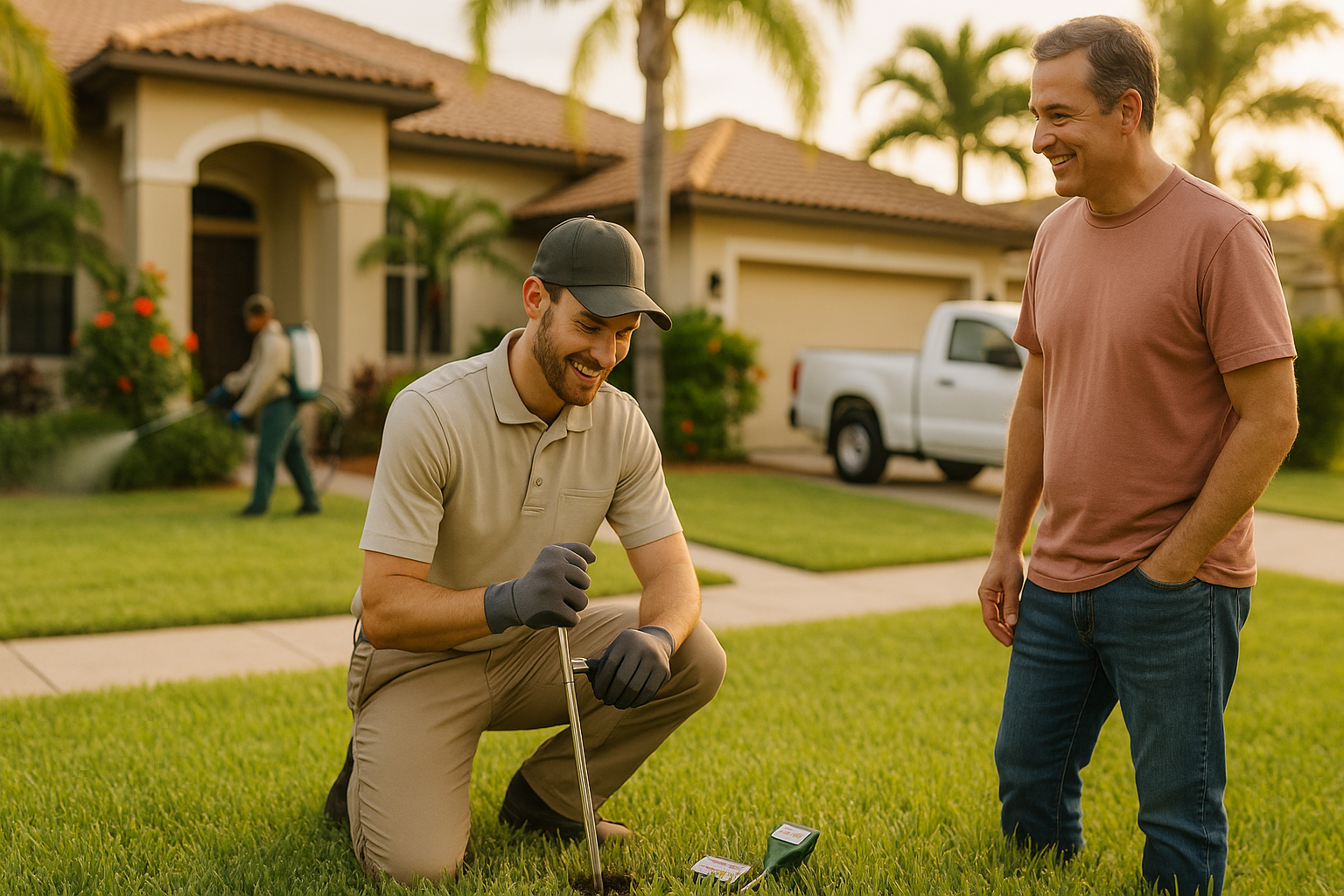
- Sample the active root zone: 3–4 inches deep in turf, using a clean trowel or probe; avoid fertilizer bands or pet spots.
- Take 8–12 cores across consistent areas (front lawn vs. side yard are different zones), then mix thoroughly in a clean bucket.
- Air-dry the composite sample (don’t oven-dry), remove debris, and fill the kit bag per instructions.
- Label zones clearly (front St. Augustine, side Zoysia, shaded bed) so recommendations match reality.
- Note recent treatments: fertilizers, lime, sulfur, or topdressing within the past 6–8 weeks can skew readings.
- Mail or drop-off the sample and request turf-specific recommendations.
- Set a reminder: retest annually if you’re correcting pH or major deficiencies; every 2–3 years for steady-state lawns.
- Share results with us: we’ll translate the numbers into a mowing, irrigation, and feeding plan that fits Florida’s seasons.
- Plan a quick follow-up walk: we’ll pair your results with a perimeter check (mulch depth, drainage, plant density) that affects pests.
Turning numbers into action: pH and nutrients, the Florida way
Once we have your Lawn Soil Testing in Florida results, we map changes that actually stick. If pH is low, we may recommend a measured dose of dolomitic lime (calcium + magnesium) to lift pH and improve nutrient uptake. If pH is high, we look at elemental sulfur applications (used judiciously), organic matter strategies, and species-specific expectations—some areas with naturally alkaline soils are better managed than “fixed.” Nitrogen should lean slow-release to avoid surge growth, and potassium should remain balanced to boost heat and drought tolerance. For Florida-friendly fertilizer context and compliance, the state’s Urban Turf Fertilizer Rule is a helpful baseline: Florida DEP: Urban Turf Fertilizer Rule.
We match these choices to your grass species and microclimate; St. Augustine cultivars, for instance, respond best to precise timing and mowing heights that limit stress—so nutrients build resilience instead of chasing color alone.
Soil-first irrigation: fewer soggy edges, stronger roots
Knowing how fast your soil drains lets us set irrigation for roots, not runoff. In general, early-morning watering that reaches the root zone (often 0.5–0.75 inches per cycle) followed by an actual dry-down protects turf and reduces the damp conditions pests love. Cycle-and-soak strategies help sandy or compacted soils absorb water without flooding slab edges. For Florida-specific watering guidance, bookmark the Florida-Friendly Landscaping program: FFL: Water Efficiently.
When we pair soil-driven irrigation with tuned nutrition, turf stands taller against weeds, disease, and insects—so we can treat precisely when needed and avoid blanket spraying.
Pest prevention that starts in the soil
Healthy turf resists problems that run wild in Florida’s humidity. For example, Southern chinch bug is notorious in St. Augustinegrass; early symptoms mimic drought in sunny patches, and weak, over-stressed lawns are easier targets. UF/IFAS offers a practical ID and management guide: UF/IFAS: Southern Chinch Bug. With soil-informed irrigation and feeding, you’ll see fewer “mystery patches” and we can deploy lawn spraying only where and when it’s warranted.
Stronger turf also keeps foundation edges cleaner and drier—shrinking harborage for large outdoor cockroaches and reducing the shaded, wet runways rodents (rats and mice) prefer. Better moisture control near slabs and piers, paired with trimmed plantings, lowers conditions that encourage termites along foundations.
From soil to structure: connecting lawn health to home comfort
Great lawns don’t stop at the property line—they change how the whole home feels. As we tune mowing, feeding, and watering from your Lawn Soil Testing in Florida results, we also tighten the perimeter with services that reinforce indoor calm. Our shrub tree care lifts and thins dense plantings that press into siding and rooflines. In shaded, moisture-heavy zones, moss spraying restores light and airflow so surfaces dry faster after storms. For stressed or nutrient-deficient trees, tree injections deliver support directly to the vascular system—strengthening canopies without overloading the soil. Together with targeted lawn spraying, these steps reduce debris and bridges pests use to reach thresholds.
Indoors, our pest control program favors precision over broadcast spraying: gel baits, insect growth regulators, and crack-and-crevice work for cockroaches; rodent exclusion that screens vents, seals utility penetrations, and tightens door sweeps so rats and mice can’t come back; and species-matched termite strategies. If bed bugs ever enter the picture (true travel hitchhikers), we’ll build a specialized plan that coordinates with your broader schedule.
When to retest—and how Wednesday helps
We like to verify progress. If we’re actively correcting pH or chasing a known deficiency, plan a retest in 12 months. In steady lawns, check every 2–3 years or after major changes (topdressing, renovation, irrigation overhaul). Using Wednesday as your midweek checkpoint, you can:
Review irrigation runtimes based on weather and soil feel (edges near the slab should dry between cycles).
Spot-check mowing height—never remove more than one-third of the blade in a single cut.
Walk the perimeter: keep mulch to about 2 inches and pulled a few inches off the slab, and trim plants touching siding or rooflines to improve airflow.
Note any off-color patches, standing water, or frass/wing piles along walls; these observations speed our diagnosis and keep treatments precise.
What we do for you: soil-driven lawn care plus whole-home protection
At Superior Spray, Lawn Soil Testing in Florida is our launchpad. We collect or translate lab results, set mowing heights by species, tune irrigation to your soil, and build a nutrition plan that fits local rules and your microclimate. When issues pop up, we use lawn spraying surgically—matched to pests, disease, and timing—so your yard strengthens without heavy collateral. Around the perimeter, our shrub tree care, moss spraying, and tree injections reinforce airflow and plant vigor where it matters most.
Because landscapes and living spaces are one ecosystem, we also deliver comprehensive pest prevention indoors. We handle cockroaches with targeted baits and crack-and-crevice techniques, protect structures with termite inspections and treatments, and implement rodent exclusion that seals gnaw points for rats and mice. If you’re ever up late searching “pest contro” after a surprise sighting, we’ll make your next step simple, safe, and effective.
And if travel introduces bed bugs, we use a focused, step-by-step program that coordinates with your lawn and perimeter schedule without conflict.
Make this Wednesday the day your lawn turns the corner
One good soil sample can rewrite your season. With Lawn Soil Testing in Florida guiding irrigation, nutrition, and mowing—and with a perimeter tuned for airflow and dry-down—you’ll see a thicker, healthier lawn and fewer pests testing your thresholds. At Superior Spray, we connect the dots: soil-smart turf care on the outside; targeted pest control, termite strategies, and rodent exclusion on the inside; and exterior services—lawn spraying, shrub tree care, moss spraying, and tree injections—that keep pressure low year-round.
If you’re exploring home health care options, let’s talk about what support looks like for your situation. Call 863-682-0700
Request Service
Request a Free Estimate
Fill out the form below. This form will take less than a minute to complete.
* indicates required fields